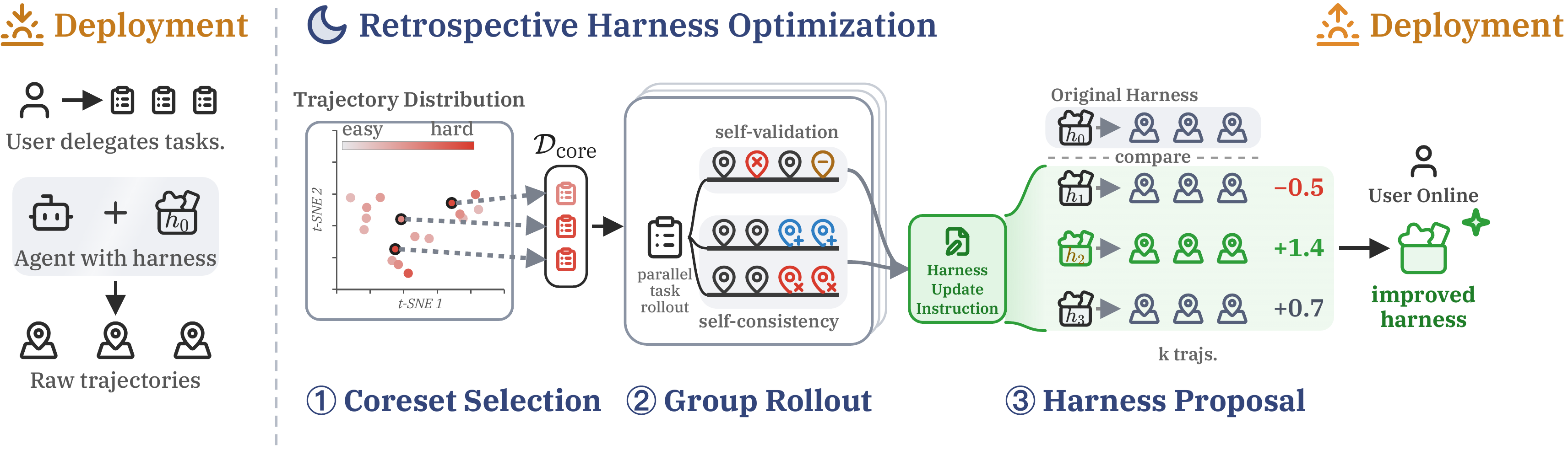
The RHO pipeline. A diverse coreset of past tasks is re-solved in parallel; within- and cross-trajectory signals drive candidate harness edits; the agent's own pairwise self-preference selects the winner. No ground-truth labels are used.
Abstract
AI agents rely on a harness of skills, tools, and workflows to solve complex problems, and continually improving this harness is essential for adapting to new tasks. Existing optimization methods typically require ground-truth validation sets, yet such labeled data is difficult to acquire in practical deployment settings.
We introduce Retrospective Harness Optimization (RHO), a self-supervised method that optimizes the agent harness using only past trajectories. RHO selects a diverse coreset of challenging tasks from past trajectories and re-solves them in parallel. The agent analyzes these rollouts using self-validation and self-consistency, then generates candidate harness updates and selects the most effective one by its own pairwise self-preference.
We evaluate RHO across three diverse domains spanning software engineering, technical work, and knowledge work. Notably, a single optimization round improves the pass rate on SWE-Bench Pro from 59% to 78% without any external grading. Our analysis shows that RHO effectively targets prior failure modes: the optimized harness alters the agent's behavior patterns and sustains higher accuracy during long-horizon sessions.
TL;DR — RHO improves an agent's harness purely from its own unlabeled past trajectories, with no validation set and no external grading. One retrospective pass: SWE-Bench Pro 59% → 78%.
How it works
Most harness optimizers iterate against a labeled validation set — but real deployments rarely have one. A deployed agent does, however, produce a continuous stream of unlabeled trajectories. RHO turns those into harness improvements in three label-free stages:
1
Coreset Selection
A determinantal point process (DPP) picks a small, difficulty-diverse subset of past tasks to re-solve.
2
Group Rollout
Each coreset task is re-solved G times in parallel, yielding two diagnostic signals: self-validation within a trajectory and self-consistency across trajectories.
3
Harness Proposal
The agent samples N candidate harness edits and keeps the one its own pairwise self-preference ranks highest over the baseline.
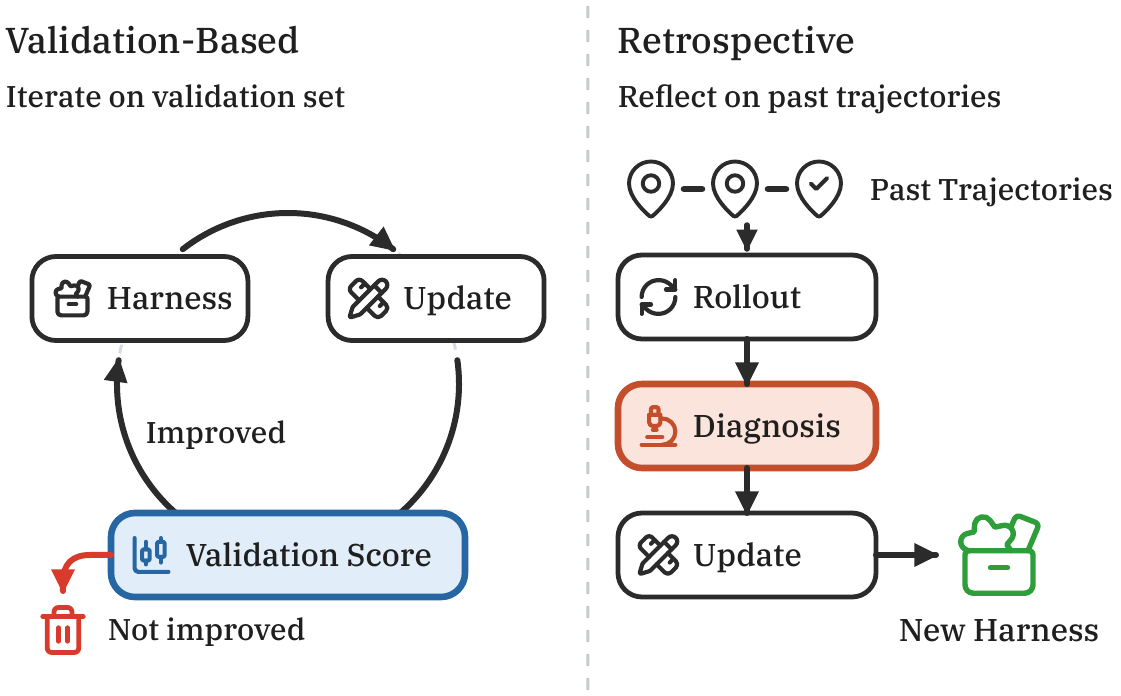
No validation set, no feedback loop
Validation-feedback methods repeatedly score harness edits against labeled data. RHO instead reflects on past trajectories in a single retrospective pass — replacing the external grader with the agent's own self-validation, self-consistency, and self-preference.
Results
Held-out pass rate after a single optimization round (Codex + GPT-5.5), against feedback-free baselines under a matched agent-call budget:
Method
Harness surface
SWE-Bench Pro
Terminal-Bench 2
GAIA-2
Vanilla Codex
—
0.59
0.71
0.29
Dynamic Cheatsheet
Skills
0.62 +0.03
0.73 +0.02
0.30 +0.01
ReasoningBank
Memory
0.61 +0.02
0.73 +0.02
0.28 −0.01
Sleep-time Compute
Memory
0.64 +0.05
0.73 +0.02
0.32 +0.03
RHO (ours)
Skills + Tools
0.78 +0.19
0.76 +0.05
0.37 +0.08
RHO also beats Meta-Harness, a validation-feedback optimizer, at a matched single-round budget (0.78 vs 0.62 on SWE-Bench Pro) — without ever touching ground-truth labels.
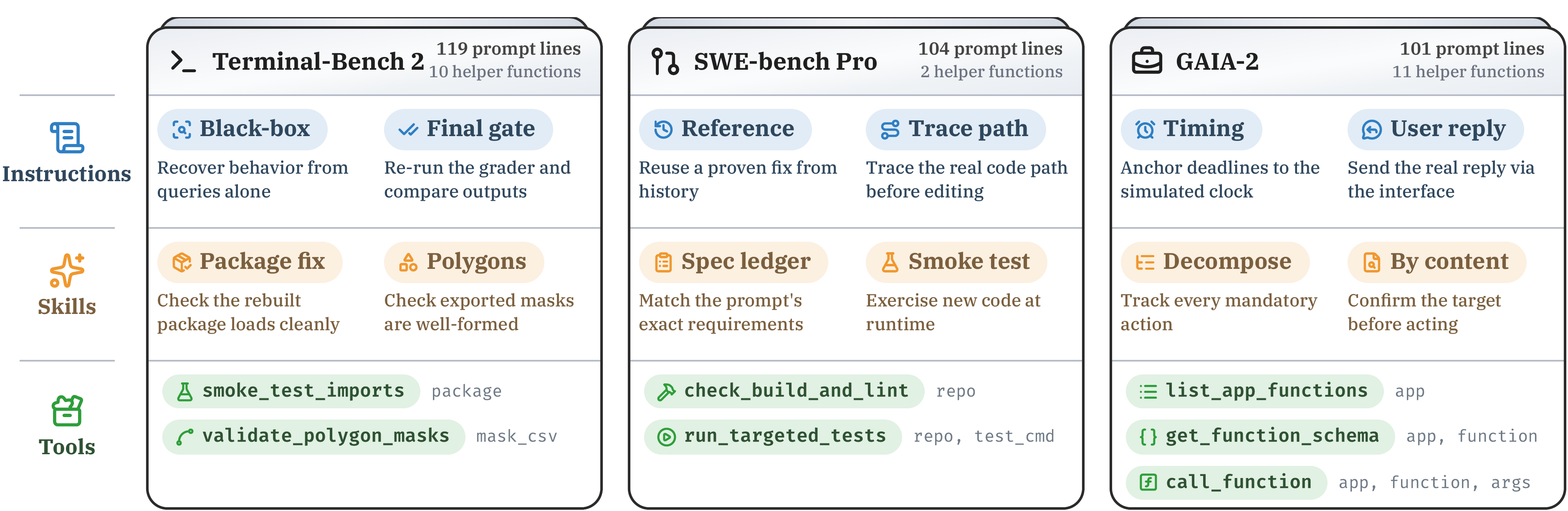
What RHO writes into the harness: task-agnostic instructions, skills that record environment idiosyncrasies behind past failures, and executable tools — each targeting a failure mode observed in the original trajectories.
Try it on your own projects
RHO learns from the sessions your agent has already produced. One line runs a full retrospection
cycle — digest past sessions, diagnose recurring failures, evolve the persistent harness, and accept
an update only when the agent's own pairwise self-preference favors it (with a backup first).
Claude Code
Recommended
Paste as a prompt — a dynamic workflow runs the cycle on the project you're in, evolving CLAUDE.md, auto-memory, and helper scripts. Plug and play.
Run the workflow at https://raw.githubusercontent.com/wbopan/retro-harness/main/.claude/workflows/retrospection.js on this project
Codex CLI
A stdlib-only Python orchestrator over codex exec — the same cycle on your AGENTS.md and skills.
Used to reproduce our results, for research purposes.
git clone https://github.com/wbopan/retro-harness && cd retro-harness && uv sync && uv run rho evolve --dataset locomo:data/locomo10.json --rounds 1
Citation
If you find RHO useful, please cite:
@inproceedings{pan-etal-2026-evolving,
    title = "Evolving Agents in the Dark: Retrospective Harness Optimization via Self-Preference",
    author = "Pan, Wenbo  and
      Liu, Shujie  and
      Lin, Chin-Yew  and
      Zeng, Jingying  and
      Tang, Xianfeng  and
      Zhou, Xiangyang  and
      Lu, Yan  and
      Jia, Xiaohua",
    editor = "Lee, Hung-Yi  and
      Dev, Sunipa  and
      Li, Jessy  and
      Elliott, Desmond",
    booktitle = "Findings of the {A}ssociation for {C}omputational {L}inguistics: {EMNLP} 2026",
    month = oct,
    year = "2026",
    address = "Budapest, Hungary",
    publisher = "Association for Computational Linguistics",
    url = "https://aclanthology.org/2026.findings-emnlp.2439/",
    pages = "52321--52362",
    ISBN = "979-8-89176-462-0"
}